


















Sustainable network transformation isn’t a new concept. In fact, because of it, the internet has been able to not only grow but keep pace with the exponentially increasing demands for connectivity and services.
This is good news for service providers, as the network is more vital today than ever before. It’s woven into the fabric of our daily life and powers the services we rely on for work, education, entertainment, and so much more. However, customer expectations for advanced service are growing as well, resulting in many service providers facing:
- Intense pressure to innovate beyond conventional connectivity
- An increasingly competitive landscape, as cloud providers look to deliver low-latency services, enabled by edge cloud computing over the top of service provider networks
- Security threats, including emerging quantum risks that expose vulnerabilities in their outdated infrastructure, jeopardizing network reliability and customer confidence
- Mounting societal and regulatory demands for sustainability, coupled with rising energy costs, that push providers to reduce energy consumption and carbon footprints while maintaining cost efficiency and phasing out legacy equipment
At Juniper Networks, we’re addressing these challenges through five transformative pillars, enabling service providers to build reliable, innovative, and eco-conscious networks that meet the needs of tomorrow’s customers.
1. Scalable network architectures
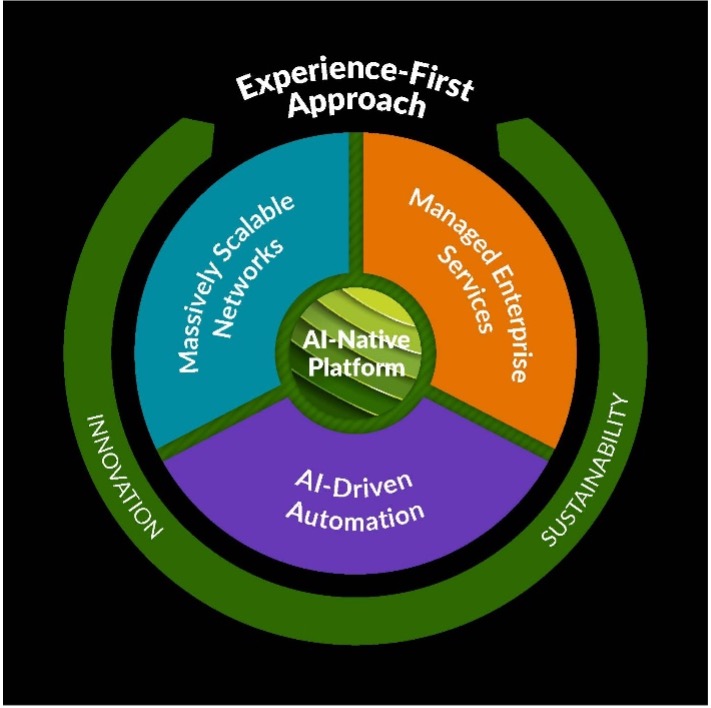
As service providers evolve to handle growing sustainability demands, they must build their networks on a solid foundation. That’s why a focus on sustainability at the hardware level is crucially important.
It starts with purpose-built silicon, designed specifically for network platforms and use cases, that offers significant efficiency advantages over general-purpose processors. We then build sustainable-by-design systems around our silicon, optimizing capacity, energy efficiency, and service assurance while simplifying operations to meet evolving demands efficiently across a wide range of network use cases.
However, transformation extends beyond speed and capacity—it’s also about designing a forward-thinking architecture that elevates the customer’s experience. By leveraging technologies like segment routing, service providers can deliver guaranteed service levels and seamless integration across their networks.
Sovereign networks are a prime example of this. With segment routing, you can easily ensure traffic stays within national boundaries while simplifying support for mission-critical applications like broadcast TV, energy monitoring, and financial services.
Hybrid cloud connectivity is another example, as Juniper Cloud Interlink simplifies multicloud deployments, and ensures secure, reliable service delivery. This enables service providers to simplify the delivery of client-to-cloud connectivity services, especially for customers looking to connect with multiple, heterogeneous clouds.
2. AIOps and automation
Today’s networks are complex and constantly in demand. Manual management is no longer viable. Full automation, powered by AI, is essential to resolve issues quickly, enhance customer journeys, and deploy new services at scale.
AI-native automation predicts network behavior, minimizes outages, and ensures a seamless experience. It enables real-time insights into device configurations and performance, streamlining operations and building reliable, monetizable services. With this visibility and control, service providers can tailor solutions to customer needs, fostering loyalty and maximizing ROI.
Juniper Routing Directory, as an example, helped Orange Egypt accelerate service delivery from days to minutes, minimizing downtime and truck rolls and reducing TCO by 27%.
3. Innovative services
More and more customers want providers to manage their networks. With Juniper Mist™ AI-native managed services, you can support enterprise IT teams by offloading network operations, enabling them to focus on their core business.
Transforming central offices and hub sites into edge clouds unlocks low-latency services for digital content, gaming, digital twins, and more. By offering GPU-as-a-Service and AI-as-a-Service, you can deliver high-demand, future-ready solutions that position your business at the forefront of innovation.
4. Secure and trusted networks
Security and trust are foundational to sustainable transformation. Without a secure infrastructure, even the most advanced network falls short. That’s why Juniper builds platforms that are robust, future-proof, and trusted to meet tomorrow’s cyber challenges.
With distributed architectures, DDoS protection, quantum-safe VPNs, and advanced MACsec and IPsec technologies, you can deliver secure, reliable solutions that empower your customers with confidence.
5. Sustainability at the core
Sustainability is no longer optional—it’s essential. Building platforms that prioritize circularity, carbon reduction, and low energy consumption is critical to meeting societal and customer expectations.
Juniper delivers solutions with sustainability at their core, helping you reduce costs, lower power usage, minimize upgrades, and phase out legacy equipment. The result? An efficient, eco-friendly network experience your customers will value.
________________________________________
Conclusion
Sustainable transformation is vital for service providers worldwide. At Juniper Networks, we’re partnering with providers to create future-ready networks that are responsive, secure, and built for the demands of today and tomorrow.
Explore our service provider solutions. Let’s build the future together.