






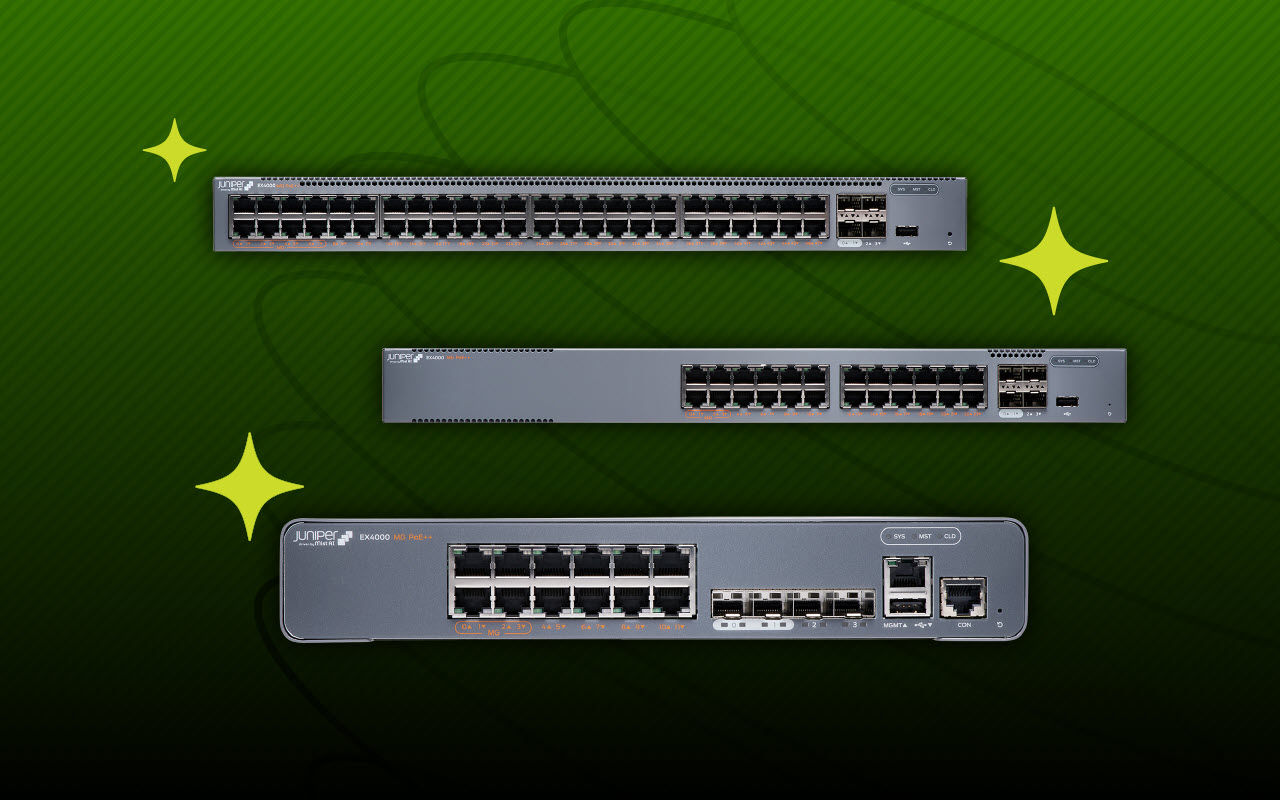









HPE Networking Chief AI Officer Bob Friday and I recently participated in a podcast with Tech Field Day. The starting premise of the show was, “Data center networking needs AI,” which we absolutely agree with. In part one of this two-part blog series we emphasized that discussions about whether and how to use AI must be rooted in your particular goals and the problems you have that need to be solved. After examining the challenges data center networking operators have, it is clear that AI can in fact help, and here’s how…
AI-native innovations extending our leadership in the data center
Improvements in AI are coming so rapidly that it will undoubtedly become an increasingly large part of the entire data center lifecycle, from Day 0 Design, to Day 1 Deployment, to Day 2 Ongoing Operations. We recently announced several new AIOps capabilities for data center networking.
- Predictive maintenance enables network operators to identify future problems and correct them before they occur.
-
- System Health. Predict when a switch will fail based on analyzing data around processor and memory utilization, temperature, etc.
-
- Capacity. Predict when you need to expand the fabric based on data around link utilization, traffic growth, etc.
-
- Optics. Predict when an optical transceiver will fail based on Tx/Rx throughput, power, voltage, etc. Gray failures in optics are always a problem and they can be worse (harder to detect) than a complete failure.
With many of these examples, when the capability is first launched it is not using AI in a dynamic, responsive way. Initially, the system often sets a static threshold, that triggers an alarm. But as good grapes make good wine, good data makes good AI. It takes some time to accumulate data and this is why Juniper has such an advantage over our competitors—we’ve been doing AIOps for 10 years with the Mist® platform. Good AI needs time to accumulate data and learn-train-learn-train and adapt, all for the goal of optimizing the user experience. In the data center, AIOps is still embryonic, but it is improving very quickly.
- Service Level Expectations entails synthesizing a wide range of network parameters and calculating summary health metrics and analyzing the issues impacting those metrics over some time period. This provides customers with a clear picture of whether their network is meeting the needs of application owners and end users.
- Documentation querying is the typical base case for virtual network assistants with which most infrastructure vendors have begun: tie an LLM to your product documentation for better search. But then you move onto more advanced uses when you tie an LLM to your actual enterprise software application or in our case network management and automation tools, and the mountains of data to which they have access. Network operators can interact with the tools in new, different, and better, ways than they might do currently; all through natural language. With Marvis™ AI Assistant, we have the best helper in the business.
- Application Assurance is essential because the entire point of a data center is to host and deliver applications to end users. Our solution combines AIOps and intent-based networking. Anomaly detection algorithms detect when a traffic flow doesn’t look right. That intelligence is combined with a deterministic understanding of which applications are flowing through which ports at a particular time—networking and application performance are tied together.
- A final category of AIOps in the data center, and perhaps the most important, is simply experimentation. Large language models (LLMs) are amazing, almost magical machines. The people who build them will admit that they don’t always understand the intuition behind how these work.
Every company, in the broadest sense of enterprise business transformation, should be grabbing foundational LLMs and fine-tuning them. Enterprises should be vectorizing the treasure troves of corporate data that they are sitting on to feed into an AI model through retrieval augmented generation (RAG). Every company that sells software should be experimenting with tying that software to LLMs and other AI models. Closer to the networking industry, we expect model context protocol (MCP) to be a key facilitator for agentic AI. If you haven’t built an MCP server for your enterprise software, do it now!
A significant amount of AI innovation over the coming years will be customer-led. When vendors put open systems into the hands of customers, you can get amazing and even unexpected results. Throughout corporate history, many industries have been transformed by revolutionary innovation driven not by suppliers, but by end users.
May you live in exciting times
Most of us are buried with information about AI out there and the speed at which it is moving. We want to stay informed but not overwhelmed. However, AI is also more accessible than ever. Anyone can download just about any of the thousands and thousands of AI models available from Hugging Face —for free! A newbie can easily build an MCP server and connect it to a number of data sources. And if you get stuck, just ask Claude to help out. LLMs are beginning to feel almost like human entities that you can interact with. It’s an exciting time to be a network engineer.